The IKEA Söderhamn Cover Guide: Modular Fit, Section by Section

A complete guide to covering the IKEA Söderhamn — modular sections, low silhouette, deep seats, and how to fit each piece of this sofa correctly.

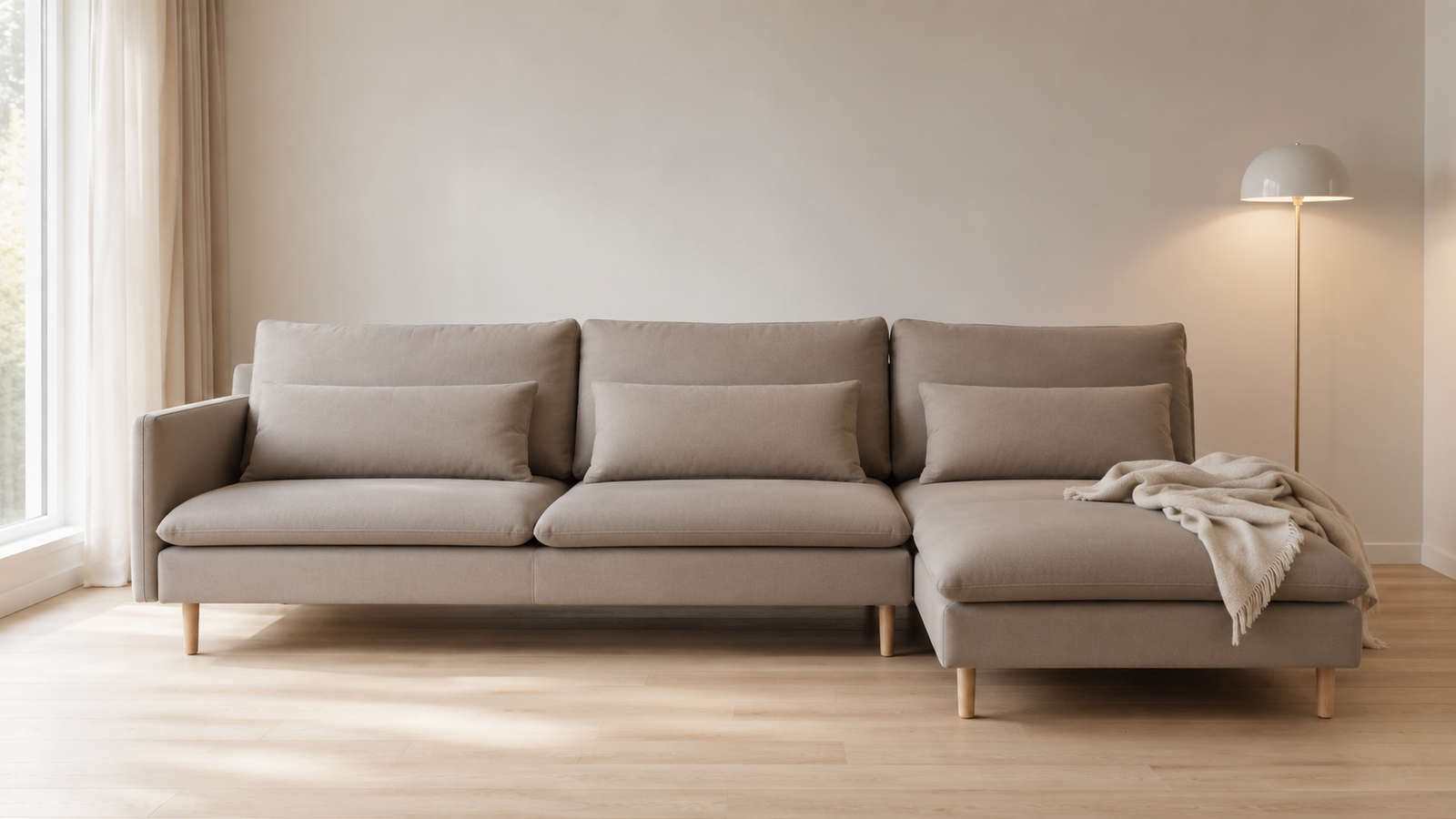
Covaba 4-seat IKEA Soderhamn modular sofa with chaise fitted in a soft greige stretch cover in a calm Scandinavian living room

The Söderhamn is the sofa IKEA designed for people who do not want a single sofa. It is a system. A one-seat module, a three-seat module, a corner section, a chaise. The modules lock together to make whatever shape your room needs, and they come apart again when the room changes. It is not so much a piece of furniture as a configurable surface for sitting.

That modularity is the Söderhamn's strength. It is also why covering one is different from covering any other sofa.

A traditional sofa has one cover for one shape. The Söderhamn has as many covers as it has modules. Each module is its own surface, with its own measurements, its own cover, its own fit. If you understand that — if you treat the Söderhamn as a set of separate pieces rather than one continuous sofa — covering it is straightforward. If you treat it as a single object, the cover will fight you.

This guide walks through the Söderhamn modular system, the common configurations, the measurements for each module, the fabric considerations specific to this sofa, and the small details that make a covered Söderhamn sit beautifully in a room.

Covaba 4-seat IKEA Soderhamn modular sofa with chaise fitted in a soft greige stretch cover in a calm Scandinavian living room

What the Söderhamn is

The Söderhamn is IKEA's low, modular sofa system, introduced in the early 2010s and still in active production. It is recognisable by three design qualities:

Low overall height. A Söderhamn sits closer to the floor than most sofas — the back of the sofa is around 83 cm tall, lower than a Kivik or an Ektorp. The visual effect is calm, almost lounge-like.

Deep seats. The seat from front to back is around 70 cm — deeper than almost any IKEA sofa in the same price range. You sit further back than you do on a standard sofa, often with your legs tucked or stretched on the seat itself rather than the floor.

Modular construction. Each section is a freestanding piece. They lock together at the joins but can be separated and rearranged. A four-seat-and-chaise configuration today can become a three-seat-and-corner tomorrow.

These three qualities — low silhouette, deep seat, modularity — are what shape every cover decision for this sofa.

Covaba IKEA Soderhamn modular system diagram showing 1-seat, corner, 3-seat, and chaise modules and their common configurations

The modules

IKEA has sold the Söderhamn in roughly these sections over the years:

One-seat section. A single seat with no armrests, just back. The building block. Used to extend other sections.

Three-seat section. Three seats in a row, no armrests on either end. A common starting point for most configurations.

Corner section. A square module that completes a right-angle bend. Has a seat surface and a back; pairs with sections on either side.

Chaise section. A long open-end section with no far armrest. Used to extend a three-seat or one-seat into a chaise lounge configuration.

Armrest module (legacy versions). Some older Söderhamns included a separate armrest piece. Newer versions are armrest-less by default.

The sections are designed to mix freely. A common home configuration combines a three-seat, a corner, and a chaise to make an L-shape. Another puts two three-seats and a one-seat together to make a long straight bench.

This means a Söderhamn cover is rarely "one cover for one sofa". It is usually one cover per module — three covers for a three-module configuration, four covers for a four-module configuration. The covers are sized to each module, not to the total shape.

Covaba close-up of two Soderhamn modular sections meeting at a corner with stretch covers fitted, showing clean seam continuity

The most common configurations

In practice, most homes have one of these:

Configuration A: 3-seat with chaise (left or right). A three-seat module joined to a chaise. Total length around 285 cm. Needs two covers — one for the three-seat, one for the chaise. The chaise side must match the orientation (left or right facing).

Configuration B: 4-seat with chaise. A three-seat plus a one-seat plus a chaise. Total length around 340 cm. Needs three covers — three-seat, one-seat, chaise.

Configuration C: L-shape (3-seat, corner, chaise). A three-seat module joined to a corner section, joined to a chaise. Total dimensions vary; the corner adds a square module that completes the L. Needs three covers — three-seat, corner, chaise.

Configuration D: U-shape (chaise, three-seat, corner, three-seat, chaise). A larger configuration combining a central three-seat with chaises at each end and a corner section. Needs five covers, one per module.

When you order covers for a Söderhamn, you are ordering by module count, not by sofa name. The total cost of fully covering a Söderhamn depends on how many modules you have.

Covaba IKEA Soderhamn cushion side-view diagram showing deep seat and low backrest with measurement points labelled

Measuring a Söderhamn

Because each module is separate, you measure each one individually. The principles are the same as any sofa measurement — total width, seat depth, back height, armrest height where applicable — but you apply them module by module.

For full measuring instructions, see how to measure your sofa. Below is the Söderhamn-specific adaptation.

Three-seat module. Width about 186 cm. Seat depth about 70 cm. Back height about 83 cm. No armrests, so no armrest height to record. The cover wraps the three seats and tucks at both ends.

One-seat module. Width about 105 cm. Same seat depth and back height. The cover is a smaller version of the three-seat cover.

Corner module. A square section, about 105 cm on each side. The cover wraps a single surface that turns the corner of your L.

Chaise module. Width about 105 cm at the head end, length about 153 cm. The chaise has one closed end (where the back meets the side) and one open end (where you extend your legs). The cover follows the same shape.

If your modules differ from these dimensions — IKEA has made minor adjustments over the years — measure your specific sofa and order based on those numbers. A stretch cover absorbs a few centimetres of variation, but ordering blind from these averages will only work if your modules match them within 5 cm.

Covaba editorial split image of an IKEA Soderhamn modular sofa rearranged in two different configurations with fitted covers

Why the deep seat matters

The Söderhamn's seat depth — about 70 cm — is unusual. Most sofa covers are designed for a 55–65 cm seat. A cover cut for a standard sofa will pull tight across the front of a Söderhamn seat and bunch where the seat meets the back. The fabric runs out.

A cover designed for a Söderhamn — or a stretch cover with enough length to be tucked generously — does not have this problem. The depth gets absorbed in the tuck, with extra fabric pushed into the space between the seat cushion and the back cushion. Matching cushion covers keep the modules looking consistent.

When ordering a cover for a Söderhamn, check: - The seat depth specification of the cover, listed in centimetres - The amount of extra fabric included for tucking, sometimes called the "tuck allowance" - Whether the cover comes with foam rods to anchor the tuck

If those three are right, the deep seat is no obstacle. If they are not specified, the cover may have been designed for a shallower sofa and will struggle here.

The low silhouette and the cover drape

A Söderhamn back is lower than most sofas — about 83 cm from floor to top of back. The cover drapes over this and tucks behind, but the lower height means there is less distance between the floor and the visible back of the sofa.

This matters for two reasons.

The cover hangs differently. A cover designed for a taller sofa has more material to drape over the back, which can pool at the floor. On a Söderhamn, that extra material has nowhere to go. Pick a cover sized for the back height, not just the width.

The room reads more horizontal. Because the sofa itself is low, the cover does not dominate the room visually. This is part of the Söderhamn's design — it sits in the room rather than commanding it. Choose a fabric that complements that quality. A subtly textured weave or a clean matte microfibre works better than a high-contrast pattern that would compete with the sofa's restraint.

Fabric for a Söderhamn

The same three fabric options apply — soft-touch microfibre, linen-look weave, boucle-style — and the full comparison is in our fabric guide. For a Söderhamn specifically:

Soft-touch microfibre. The most common and practical choice. The Söderhamn is often the primary sofa in a household, and the deep seats invite stretching out, napping, and casual use. Microfibre handles that pattern of use better than the other two.

Linen-look weave. Suits a Söderhamn in a more curated room — soft lighting, neutral palette, low coffee table, considered objects. The Söderhamn's horizontal silhouette pairs well with the linen-look's woven character.

Boucle-style. A surprisingly natural fit for a Söderhamn. The low silhouette gives the boucle texture room to read without overwhelming the rest of the space. A boucle Söderhamn in cream or warm sand is one of the most visually distinctive sofa-and-cover pairings in a calm living room. Best suited to a Söderhamn in a quieter household.

A Söderhamn covered well in any of these three fabrics is a different sofa than the original IKEA cover. The shape is the same; the room reads completely differently.

How the covers fit together at the joins

Where two Söderhamn modules meet, two covers meet. This is the visual moment that separates a well-covered Söderhamn from one that looks awkward.

The trick is that each cover ends where its module ends, with the fabric tucked cleanly into the gap between modules. When two modules sit flush together, the covers meet edge to edge with the fabric folded into the join. From a viewing distance, the seam is invisible.

A few small habits help:

Order all covers in the same colour and fabric. Even within the same fabric, slight dye variations can occur between batches. Order all the covers you need at the same time to ensure they match.

Fit one module at a time, then push them together. Fit each cover on its module separately, with the modules slightly apart. Once each module is covered, slide them back together. The covers will meet cleanly at the joins.

Smooth the joins. Once the modules are together, run your hand along the join and smooth any pinched fabric into the gap. The seam should sit naturally, neither bulging nor pulled.

If you do this on each join, a multi-module Söderhamn reads as one continuous covered surface — even though it is technically three or four separate covers.

The reconfiguration problem (and the solution)

A Söderhamn is built to be rearranged. You move house, you change the room layout, you decide the chaise should sit on the other side. The modular system makes this easy — but a cover designed for one configuration does not automatically fit another.

The good news: because each cover is sized to its module, rearranging the modules rearranges the covers with them. A chaise cover is still a chaise cover, whether the chaise sits on the left or right of the rest of the sofa. The exception is chaise-orientation: if your chaise is left-facing in one configuration and right-facing in the next, you will need a new cover or one that fits either side.

When you order covers for a Söderhamn, think about whether you are likely to reconfigure the sofa in the future. If yes, choose covers in a neutral colour that will work across multiple room layouts. If no, choose whatever fits the current room.

Browse the full range in our corner sofa covers and stretch sofa covers collections — both include Söderhamn-compatible sizes.

Care: same as any stretch cover

Söderhamn covers wash and dry the same way any stretch cover does. Cool wash. Mild detergent. Low spin. Air dry or low tumble. Refit while slightly damp.

One small note: because each module is its own cover, you can wash them in rotation rather than all at once. If one section gets more daily use than others — say, the chaise where someone naps every evening — that cover can be washed monthly while the others wait two or three months. Modular sofas allow modular care.

The full care routine is in our sofa cover care guide.

The thinking behind a covered Söderhamn

A Söderhamn is a sofa designed to last through several seasons of a life — first apartment, then a bigger one, then a house, then a different house, then a child's room when the family upgrades. The frame supports that. The modules support that. The original cover, almost always, does not — it ages in the wrong colour, shows the wear of the years, and starts to make the whole sofa look older than it actually is.

A new cover, module by module, gives the sofa back its first-day clarity. The frame stays. The modules stay. The room around the sofa changes because the sofa itself reads new.

This is the principle behind everything Covaba makes: keep what you love, change how it feels. A Söderhamn is one of the best sofas in the world to apply this thinking to, because the modular design rewards renewal at every stage. Read more about how this thinking shapes the brand on our story.

Cover it module by module. Let the joins meet cleanly. Choose the fabric for the room you want, not the room you have.

The sofa was always going to last. Make sure the cover does, too.


FAQ

Q1: Do I need a separate cover for every module? A1: Yes. Each Söderhamn module is a freestanding section, and each one gets its own cover. A four-module sofa needs four covers. They are sold individually because the configurations vary so widely from home to home.

Q2: My Söderhamn has a chaise. Does it matter which side it's on? A2: Yes. A chaise cover is shape-specific — a left-facing chaise needs a left-facing cover. If you reconfigure the sofa and switch the chaise to the other side, you may need a new cover.

Q3: The Söderhamn has very deep seats. Will a stretch cover fit? A3: Yes, but check the seat depth spec on the cover before ordering. A cover designed for shallower sofas will pull tight; a cover with a 70 cm seat depth (or generous tuck allowance) will fit a Söderhamn comfortably.

Q4: Will all the modules match if I order at different times? A4: Probably, but small dye variations can occur between manufacturing batches. To be safe, order all the covers you need in one purchase. If you need to reorder later, ask whether the same dye lot is still in stock.

Q5: My Söderhamn is from an older IKEA range — will modern covers still fit? A5: Usually yes. IKEA has kept the Söderhamn dimensions consistent over the years with only small adjustments. Measure your modules and compare to the size chart before ordering.

Q6: How do I cover the join between two modules cleanly? A6: Fit each cover on its module separately, with the modules slightly apart. Then slide the modules back together so the covers meet at the join. Smooth any pinched fabric into the gap. From normal viewing distance, the seam is invisible.